
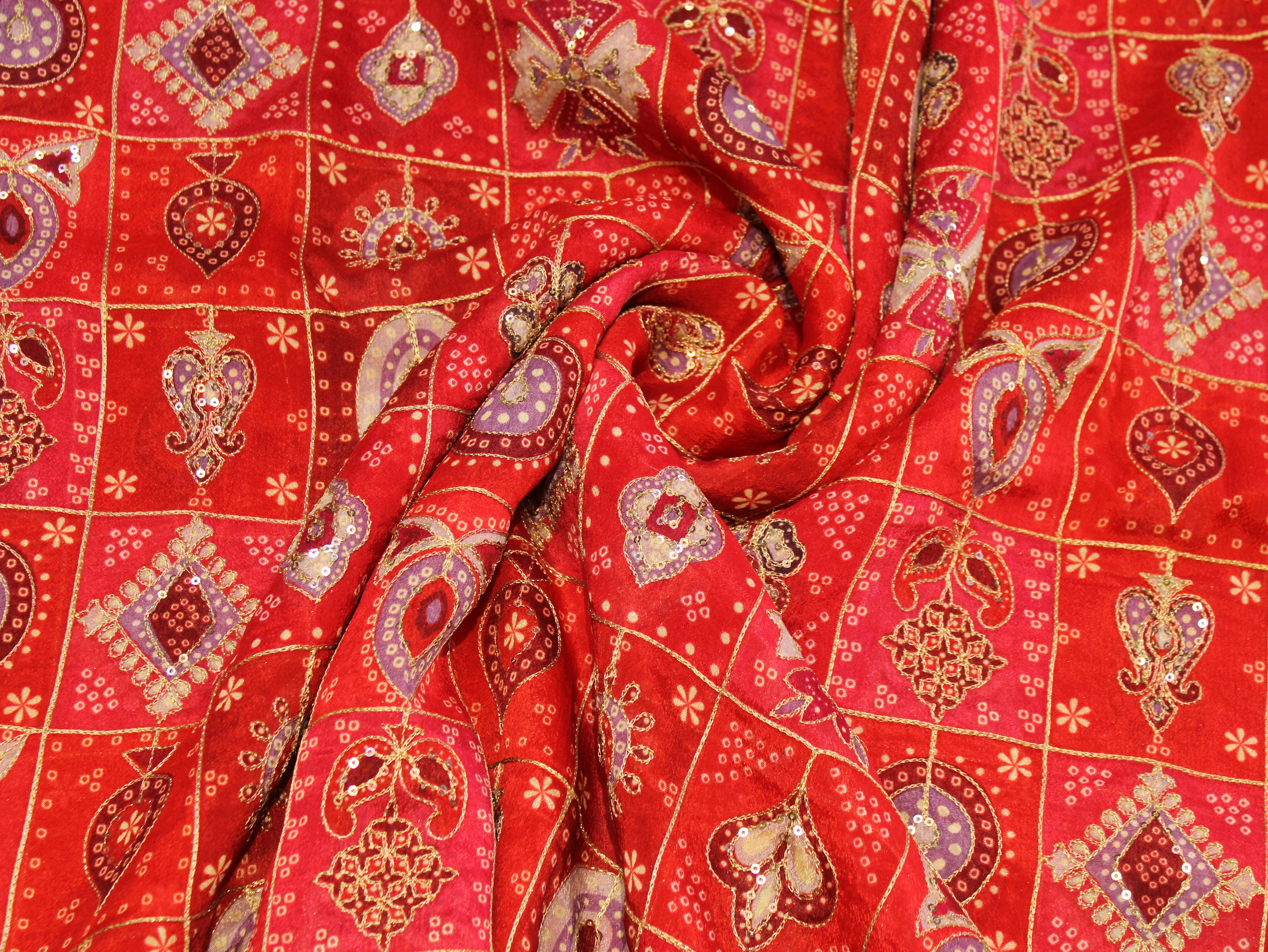
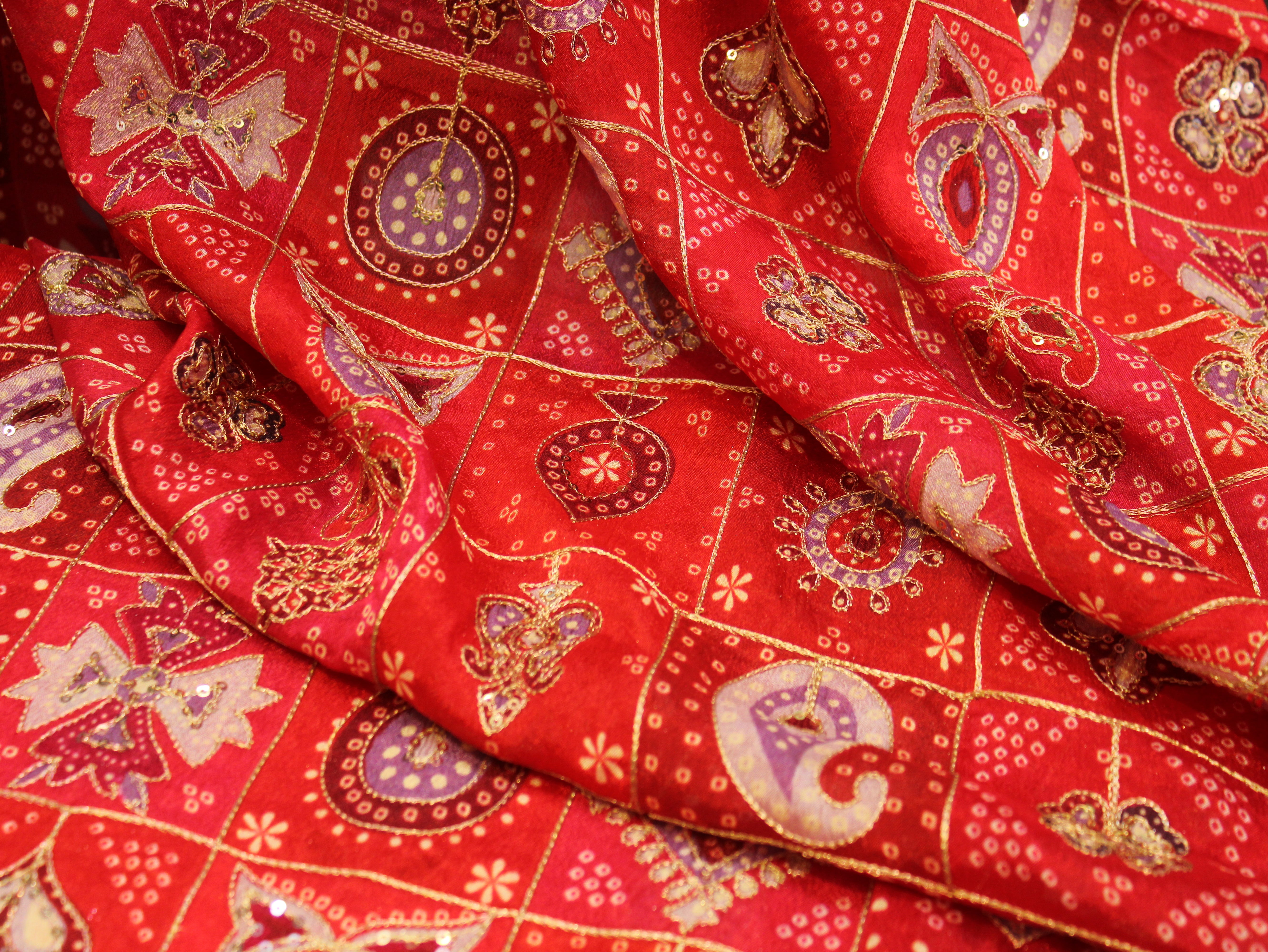
Chinon Bandhini Position Work Fabric | 42 Inch | Poly Viscose | Red
About This Fabric
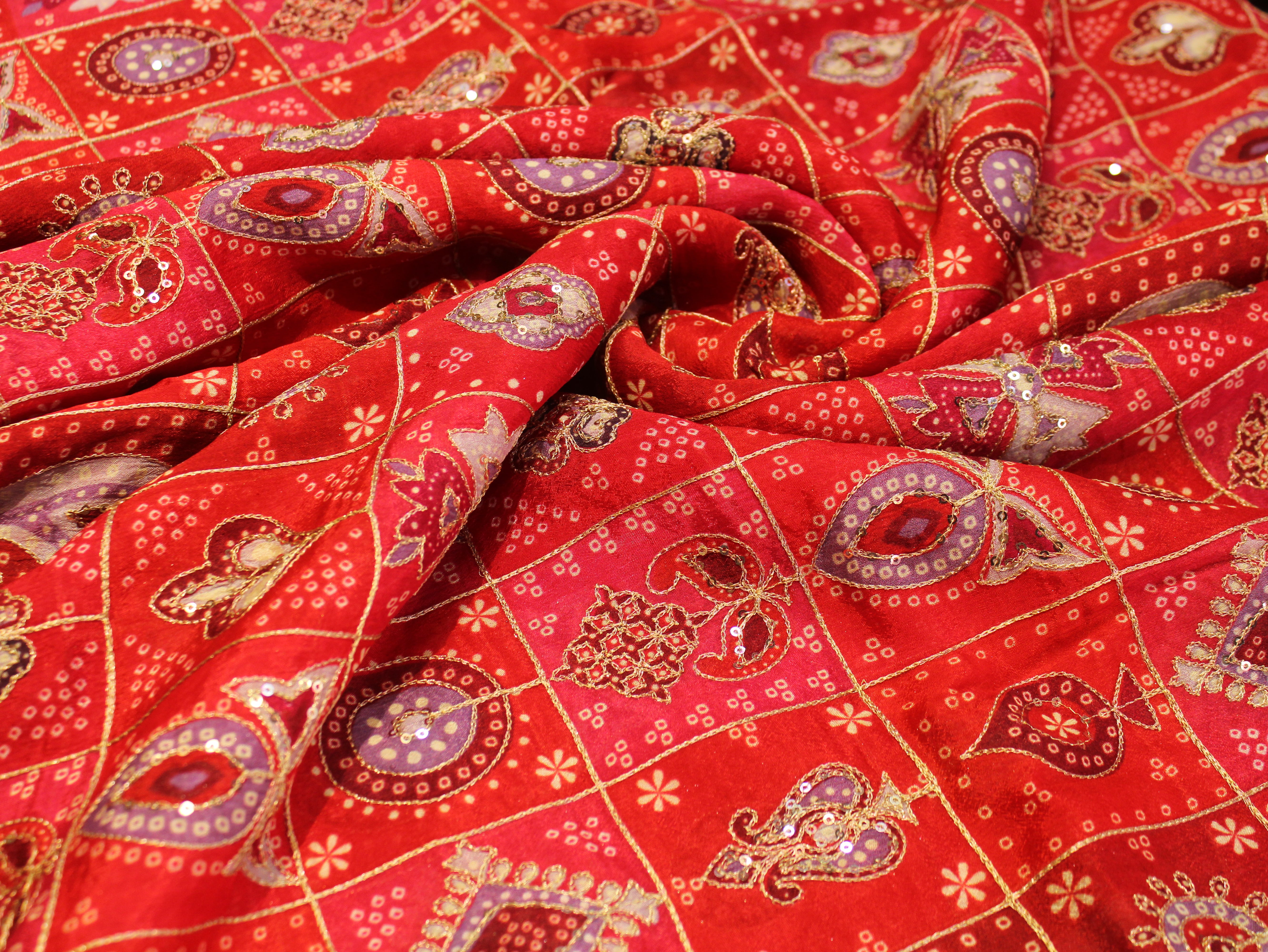
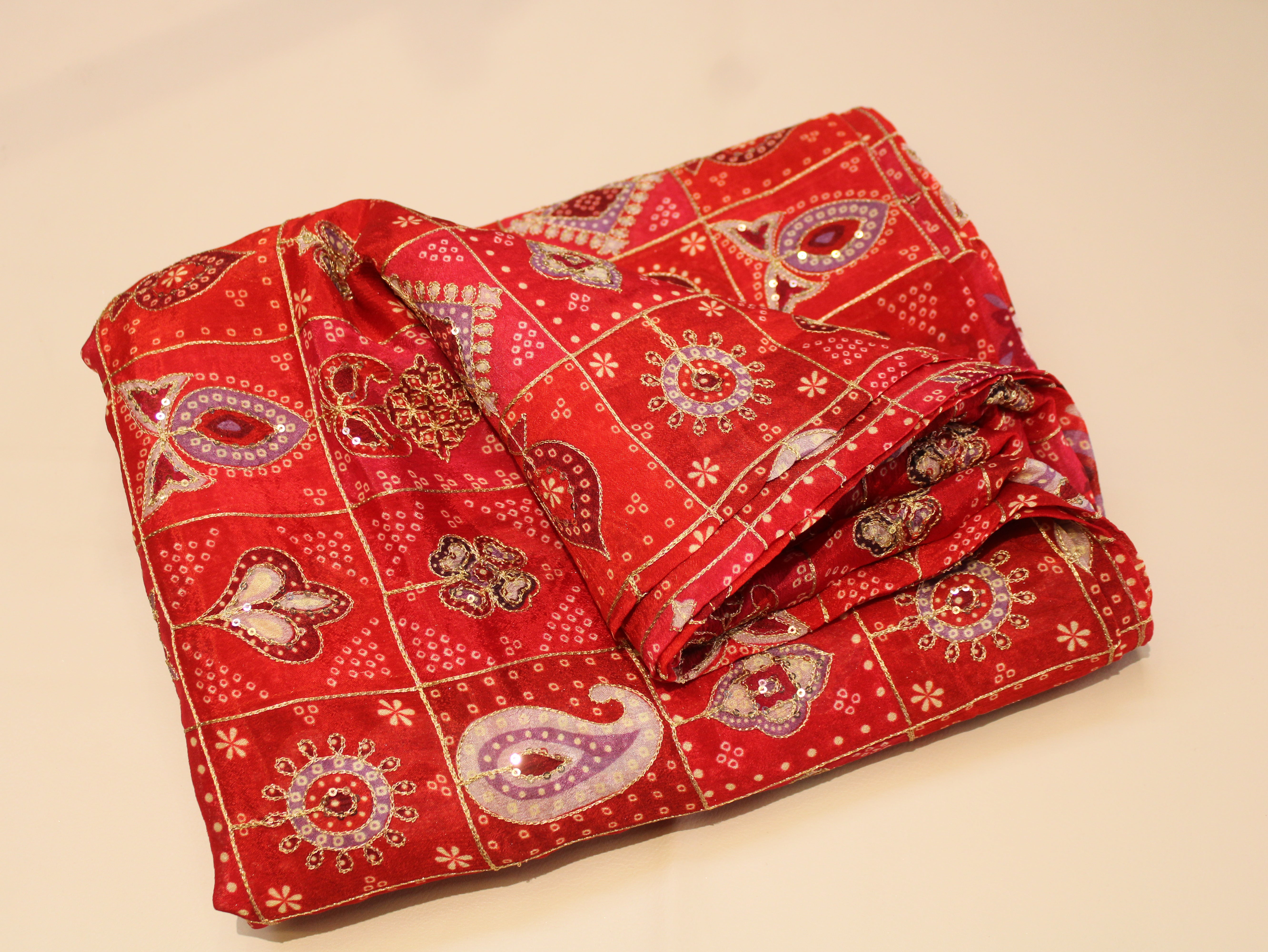
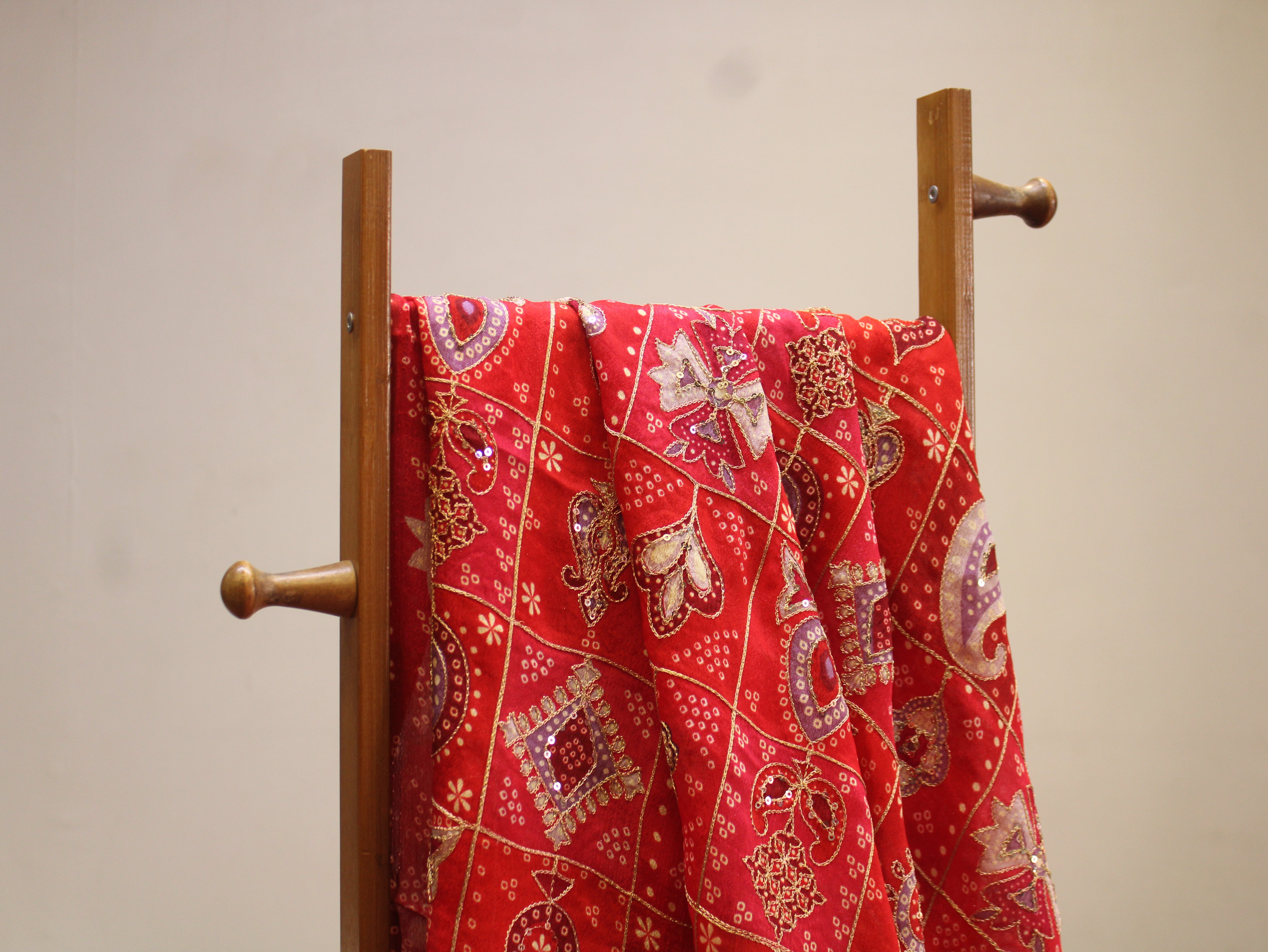
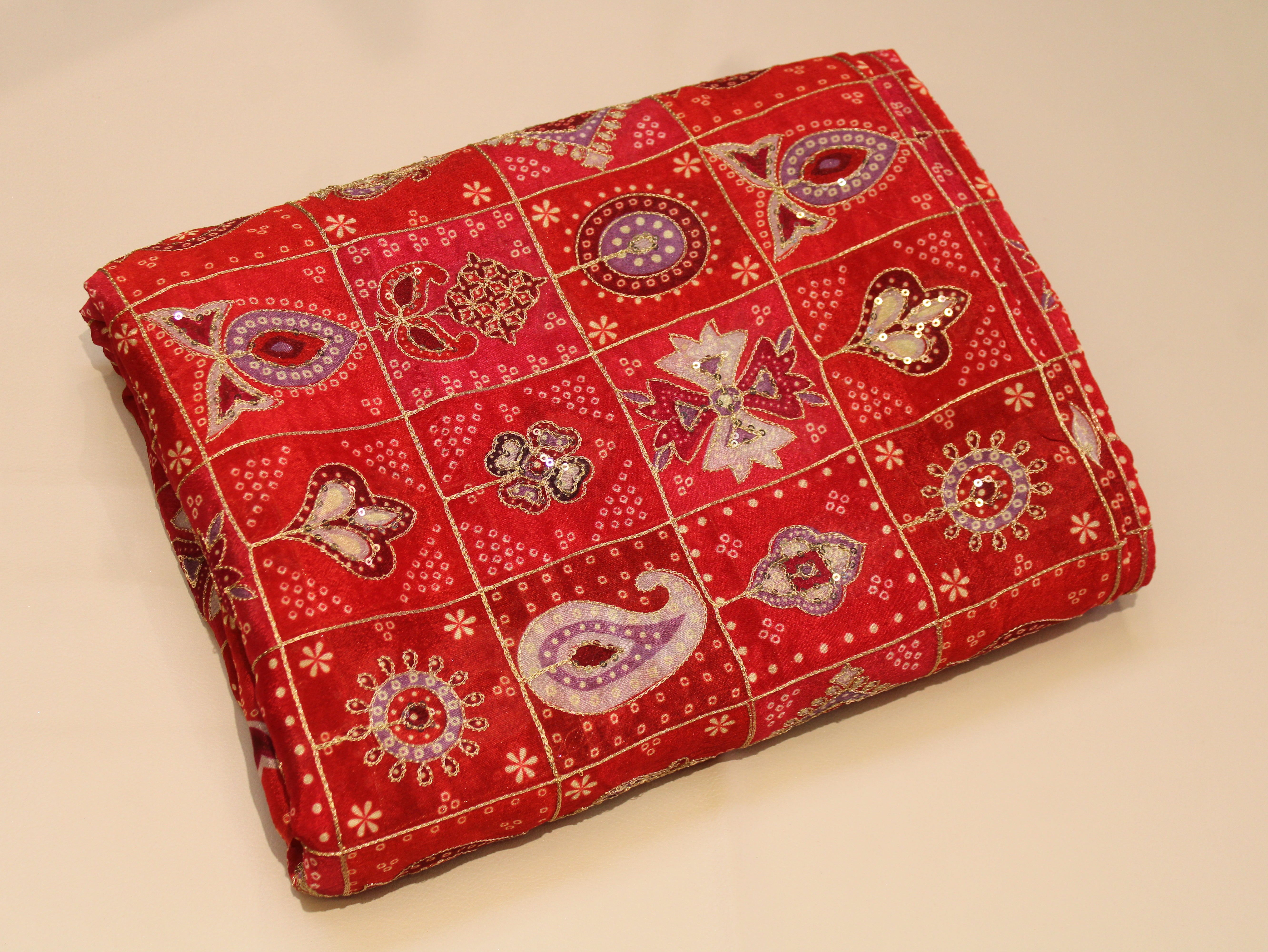
M'Foks Pure Chinon Bandhini Position Work is a poly viscose chinon fabric carrying a Rajasthani Bandhini-inspired print placed as a position design — meaning the print is deliberately located on a specific part of the fabric width and length rather than repeated as an allover pattern. This placement technique is used to ensure the Bandhini motif falls precisely on garment borders, dupattas, saree pallus, or kurta yokes, creating a finished, styled effect directly from the fabric without any additional embellishment work.
Chinon is a soft, semi-opaque woven fabric made from a polyester-viscose blend. The poly component adds durability, shape retention, and easy-care properties, while the viscose component gives the fabric its characteristic softness, fluid drape, and silk-like surface feel. Together, the blend produces a fabric that moves beautifully in motion — ideal for flowing garments like sarees, dupattas, and kurtas where the drape is as important as the print. At approximately 100 grams per metre, the weight is light-to-medium: enough structure to hold a kurta or stole shape, light enough for layered drapes and dupattas.
The Bandhini work is executed in the traditional tie-dye aesthetic of Rajasthan — small circular or diamond-shaped resist-print dots arranged in grids, rows, or artistic motif clusters that recall the handcrafted Bandhej tradition of Jaipur and Jodhpur. The position placement on this fabric means the motif is concentrated in a specific zone — saree border-style, dupatta end panels, or kurta yoke width — making the fabric ready-to-stitch with minimal design planning required from the tailor. Total fabric width is 42 inches; the Bandhini work spans 38 inches of that width.
What You Get
- Poly Viscose Chinon — soft, fluid, silk-like drape with good durability
- Bandhini-inspired position work — motif placed in specific zone, not allover repeat
- Traditional Rajasthani Bandhini aesthetic — dot/circle resist-print clusters
- Total width 42 inches — Bandhini work spans 38 inches of width
- Light-to-medium weight at ~100 GSM — fluid drape for sarees, dupattas, kurtas
- Soft, smooth texture — comfortable against skin as a top layer or draped garment
- Position print — design aligned for saree border, dupatta end, or kurta yoke use
- Multiple design and colour options available
- Low maintenance — gentle machine washable
- Made in India
Technical Specifications
| Fabric Name | Pure Chinon Bandhini Position Work Fabric |
| Composition | Poly Viscose Blend (Polyester + Viscose) |
| Fabric Type | Chinon — semi-opaque, soft, fluid woven fabric |
| Print Type | Bandhini-inspired position work print |
| Print Aesthetic | Rajasthani Bandhini — dot/circle resist-print motif clusters |
| Total Fabric Width | 42 inches / 107 cm |
| Bandhini Work Width | 38 inches / 97 cm (print zone) |
| Fabric Weight | Approx. 100 GSM |
| Texture | Soft, smooth, silk-like surface — light-to-medium weight |
| Drape | Fluid, flowing — suitable for draped and stitched garments |
| Available Designs | Multiple Bandhini designs and colour combinations |
| Shrinkage | Low — poly viscose blend, minimal shrinkage |
| Suitable For | Women's and men's ethnic garments, stoles, scarves |
| Country of Origin | India (Rajasthani Bandhini craft) |
| HSN Code | 55151140 |
| GST Rate | 5% |
Common Questions
What garments is this fabric best suited for?
Womenswear: saree, dupatta, kurta, anarkali, palazzo set, stole, kaftan. Menswear: kurta, Nehru collar shirt, stole. The position print is especially effective for sarees (the Bandhini border runs along one edge), dupattas (end panels), and kurtas (yoke panel placement). Stoles and scarves also work beautifully as the 38-inch work width fills a standard stole width completely.
What does "position work" mean in this fabric?
Position work means the Bandhini print is placed in a specific location on the fabric — not repeated end-to-end like a regular allover print. Typically, the motif runs along one edge of the width (like a saree border), across both ends of a dupatta length, or across the yoke width of a kurta. When you cut the fabric, you plan your garment piece layout to fall within the printed zone — this is why knowing the work width (38 inches) separately from the total fabric width (42 inches) is important.
What is Chinon fabric and how does it feel?
Chinon is a poly-viscose woven fabric with a semi-opaque, smooth surface and a naturally fluid drape. It feels soft and silk-like against the skin — closer in hand to crepe or georgette than to a stiff fabric. It is not sheer but is lightweight enough to layer. For garments that need to move fluidly — sarees, dupattas, flowing kurtas — chinon is an ideal base fabric.
How many metres do I need?
Saree: 5.5–6 metres. Dupatta: 2.5 metres. Kurta (women's): 2.5–3 metres. Anarkali (full length): 3–3.5 metres. Men's kurta: 2.5–3 metres. Stole: 2–2.5 metres. For position-work fabric, plan your cutting layout before ordering to ensure the printed zone falls on the right garment panels — add 10% for layout adjustments.
Is the 2-inch plain selvedge on each side usable?
The 2 inches of plain fabric on each side (total fabric width 42" minus work width 38" = 2" each side) can be used for seam allowances, facing, and inner panels where the print is not visible. For the main visible panels of the garment, plan your layout within the 38-inch work width to keep the Bandhini motif fully intact and centred.
Is this suitable for a man's kurta?
Yes. The 38-inch work width is sufficient for the front panel of a standard men's kurta with the Bandhini motif visible across the full chest and body. The soft chinon drape gives a relaxed, festive look suitable for casual ethnic occasions, Eid, or family functions. Pair with plain churidar or pyjama in a matching colour from the Bandhini print.
Cutting Tips & Care
Cutting & Stitching Tips
-
1Plan your layout before cutting
Since the Bandhini print is a position design and not allover, lay your garment pattern pieces on the fabric before cutting to verify the printed zone falls within each visible panel. The 38-inch work width means you have approximately 97 cm of print — sufficient for a standard saree border, full dupatta width, or full kurta front panel.
-
2Handle chinon carefully while cutting
Chinon is a slippery fabric. Pin it to a cutting mat or use weights to hold it in place. Use sharp scissors or a rotary cutter. Cut on a single layer for more accurate results, especially for curved necklines or shaped hems.
-
3Finish raw edges before stitching
Poly viscose frays at cut edges. Finish immediately with a serger, overlocker, or tight zigzag stitch. Pinked shears alone are not sufficient for this fabric weight.
-
4Needle and thread
Use a fine ballpoint or microtex needle (size 70/10 or 75/11) with fine polyester thread. A smaller needle reduces visible stitch holes on the soft chinon surface. Use a slightly longer stitch (2.5–3 mm) to prevent puckering on the lightweight fabric.
-
5Lining recommendation
Chinon is semi-opaque at 100 GSM — for structured garments like fitted kurtas or kurta yokes, a lightweight inner lining (cotton voile or thin poly lining) adds structure and opacity. For sarees and dupattas, no lining is needed.
Care Instructions
-
•Washing
Hand wash cold with mild detergent, or machine wash on a gentle cycle in a mesh laundry bag. Wash inside-out to protect the Bandhini print colours on first wash.
-
•Drying
Hang in shade or lay flat. Do not wring or twist — chinon loses its drape shape when wrung while wet. The fabric dries quickly due to the poly component.
-
•Ironing
Low to medium heat on the synthetic setting. Iron on the reverse side to protect the printed surface. Do not use steam directly on the Bandhini print — some print inks can bleed under high steam.
-
•Storage
Roll loosely or fold gently along the grain. Store away from direct sunlight to prevent colour fade in the Bandhini print, especially in brighter shades like red, pink, and yellow.
⚠ The Bandhini work width is 38 inches — plan your cutting layout within this zone. The 2-inch plain area on each side of the print zone should be used for seam allowances or non-visible inner panels. Do not attempt to overdye or bleach this fabric — the Bandhini position print is fixed and cannot be altered at home.
Packed & Marked By:
Mangaldeep & Concept
Address: 3, Kankariya Complex, beawar - Rajasthan 305901
India
Customer Support:
WhatsApp: +91 7597878011
Email: info@mfoks.com
Choose options